Author: Tiffany Marsh

Have
you ever thought of a grave being locked up in a cage like a wild animal? A Mortsafe allowed this to be accomplished
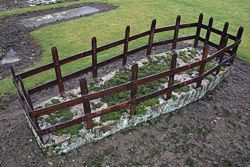
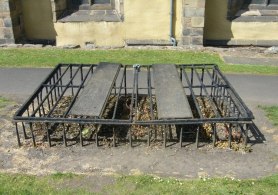
very easily. Around 1816, the Mortsafe was created. These were heavy iron or iron-and-stone devices with a variety of designs. Frequently, these were
intricate, heavy iron devices consisting of rods and plates that were padlocked
together; remnants of them may be discovered near every medical school in
Scotland. Rods with heads were inserted through holes in a plate that covered the coffin. By placing a second plate over the first to create incredibly thick
protection, these rods were held in place. Two people with keys would remove
it, after covering the coffins for roughly six weeks, after the corpse had
properly decomposed, and use them again.
“A Cage for The Dead- The
Mortsafe”( video published by Phoenix History)
The question is, why were Mortsafes used in the first place? Mortsafes have only ever been used to keep the dead safe from the living. They were intended to serve as a deterrent against body snatchers, often referred to as Resurrection Men, who preyed on graveyards in the early 1800s, removing fresh corpses from their tombs and selling them to nearby anatomy schools so that they could be dissected in anatomy classes. According to an article published by Virginia Department of Historical Resources, “Before modern laws were set in place to give medical schools access to human remains, anatomy professors struggled to acquire bodies. Those of prisoners condemned to death would end up on their tables, but there were
nowhere near enough bodies to meet demand. This led to a black market in the
remains of the recently deceased.” (DHR)
The progress made in the study of anatomy and medicine is closely linked to the illicit activity of body snatching. The practice of taking bodies from cemeteries for sale…mainly to medical colleges where they were utilized for anatomy and dissection classes. According to the PBS article titled “ Body snatching around the World”, “In fact, the first known case of body snatching was committed by four medical students in Bologna in 1319. Several years earlier the famed professor at Bologna, Mundinus, had revived the study and teaching of anatomy. He conducted public dissections of bodies, usually those of condemned criminals.” (Body Snatching Around the World | History Detectives | PBS) Although, many of the bodies stolen were those of condemned criminals, some people went out of their way to make bodies available quicker.
A great example of this are the crimes that were committed by William Burke and William Hare. As said before, there was a great need for bodies in anatomy classes. According to the “Burke and Hare” article written by The University of Edinburgh, “During the 19th century, there was a chronic shortage of cadavers for anatomy classes in Edinburgh. This gave rise to a new industry in the city: grave robbing. The best-known of the 'Resurrection Men' were William Burke and William Hare, who took the grisly practice one step further. The pair murdered at least 16 people during the period 1827-1828, selling the cadavers to Dr Robert Knox's anatomy school.” (“Burke and Hare”) This continuous stealing of bodies, along with the added practice of murdering individuals to provide to medical schools; caused a very large concern to families.
Many people no longer felt safe and did everything they could to protect their loved ones. Even putting them in cages…
Works cited:
“Body Snatching
around the World | History Detectives.” PBS, Public Broadcasting Service, www.pbs.org/opb/historydetectives/feature/body-snatching-around-the-world/Accessed
26 Oct. 2023.
“Burke and Hare.” The University of Edinburgh, 22
Sept. 2021, www.ed.ac.uk/medicine-vet-medicine/about/history/burke-and-hare.
DHR. “Mortsafes.” DHR, 25 May 2023, www.dhr.virginia.gov/blog-posts/mortsafes
“Mortsafe.” Thevintagenews, www.thevintagenews.com/wp-content/uploads/sites/65/2016/10/Mortsafes-in-Logierait-kirkyard.-Photo-Credit-640x480.jpg.
Phoenix History. “A Cage for the
Dead - the Mortsafe.” YouTube,
8 July 2023, www.youtube.com/watch?v=GsWmoDF1rbo.
Links for Further Research:
“Archaeologists in West Bromwich Find Grave Robbing Evidence.” BBC News, www.bbc.com/news/uk-england-birmingham-21044770. 17 Jan. 2013. This short article published by BBC News discusses the evidence of grave robbing in West Bromwich which led to the use of Mortsafes to lower the risk of bodies being stolen. For the grave robbers who supplied the anatomy and medical schools being established in Birmingham in the late eighteenth century, West Bromwich would have been a prime target. The purpose of this article is to explain how important it was to have protection over graves in the 19th century, even though many families were still afraid that body snatchers would be able to take their loved one’s body.
Brian Ferguson. "Biggest ever exhibition examining crimes of Burke and Hare set to open in Edinburgh". Edinburgh Evening News, advance.lexis.com/api/document?collection=news&id=urn:contentItem:65SS-4641-F15H-21GB-00000-00&context=1516831. 27 Jun. 2022. This newspaper article written by Brian Ferguson focuses on the true crime stories of William Burke and William Hare. These two men were known as “Resurrection Men”, which sparked a large public outcry in Edinburgh. Burke and Hare would set out to kill the most “valuable” people, which were usually considered to be those which would most likely have a Mortsafe.
“WHITFIELD J. BELL, Body-Snatching in Philadelphia, Journal of the History of Medicine and Allied Sciences, Volume XXIII, Issue 1, January 1968, Pages 108–b 109, https://doi.org/10.1093/jhmas/XXIII.1.108-b. This text written by J. Bell Whitfield discusses the events of body snatching within Philadelphia. The purpose of this article is to give some information on other places body snatching has occurred other than the UK.