Showing posts with label Bones. Show all posts

Tuesday, April 2, 2019

Sedlec Ossuary

Author: Micah M. Mathis


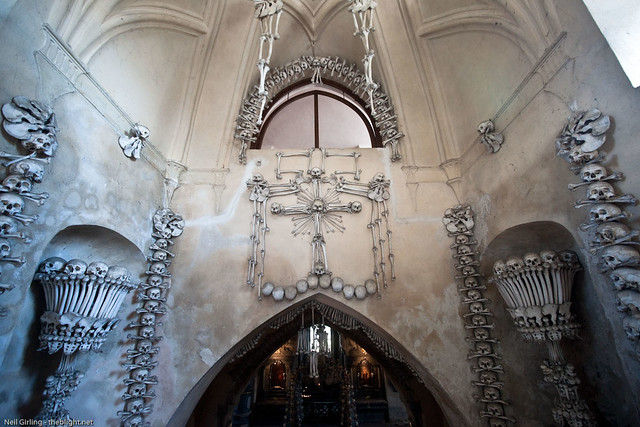
Historians and Anthropologists have made it clear that there are Seven Wonders of the World. However, they may be wrong. The following image above can clarify that this should also be apart of the Seven Wonders. Turning The Seven Wonders of the World into, “The Eight Wonders of the World.” The Macabre Bone Church also known as, The Sedlec Ossuary, is an old burial ground in the quiet town of Kutna Hora, in the heart of Czech Republic. Dating back to 1278, King Otakar II of Czech Republic, ordered Abbot, a blind monk, to handcraft this ossuary to store the remains of humans in this old chapel. King Otakar II sent Abbot to Jerusalem to obtain soil from the Golgotha, known as, “Holy Soil” to bless the Ossuary. When news got out about this, many people wanted to be buried here as well, thus making it the most religious burial site in Europe. When the Bubonic plague reached Kutna Hora, it massacred over 30,000 citizens, making the Ossuary home to over 40,000 human remains. This ossuary is meant to be seen as a fascinating site and remotely strange due to human remains being instilled in this ossuary. By the fifteenth century, the community began to construct the Gothic Church. Later, many bones were removed and stacked into a pyramid-shaped in the ossuary beneath the new building. However, the construction was placed on hold until the 1870s when the Gothic Church hired a local woodcarver, Francis Rint, to create something magnificent, yet ghoulish look for the future tourist to always remember. Rint bleached each bone and used it to decorate the holy space. Creating chains of skulls to stretch across the entryways so tourist can feast their eyes on the three-hundred-year-old remains. Chalices and crosses were constructed from human femurs and hips.
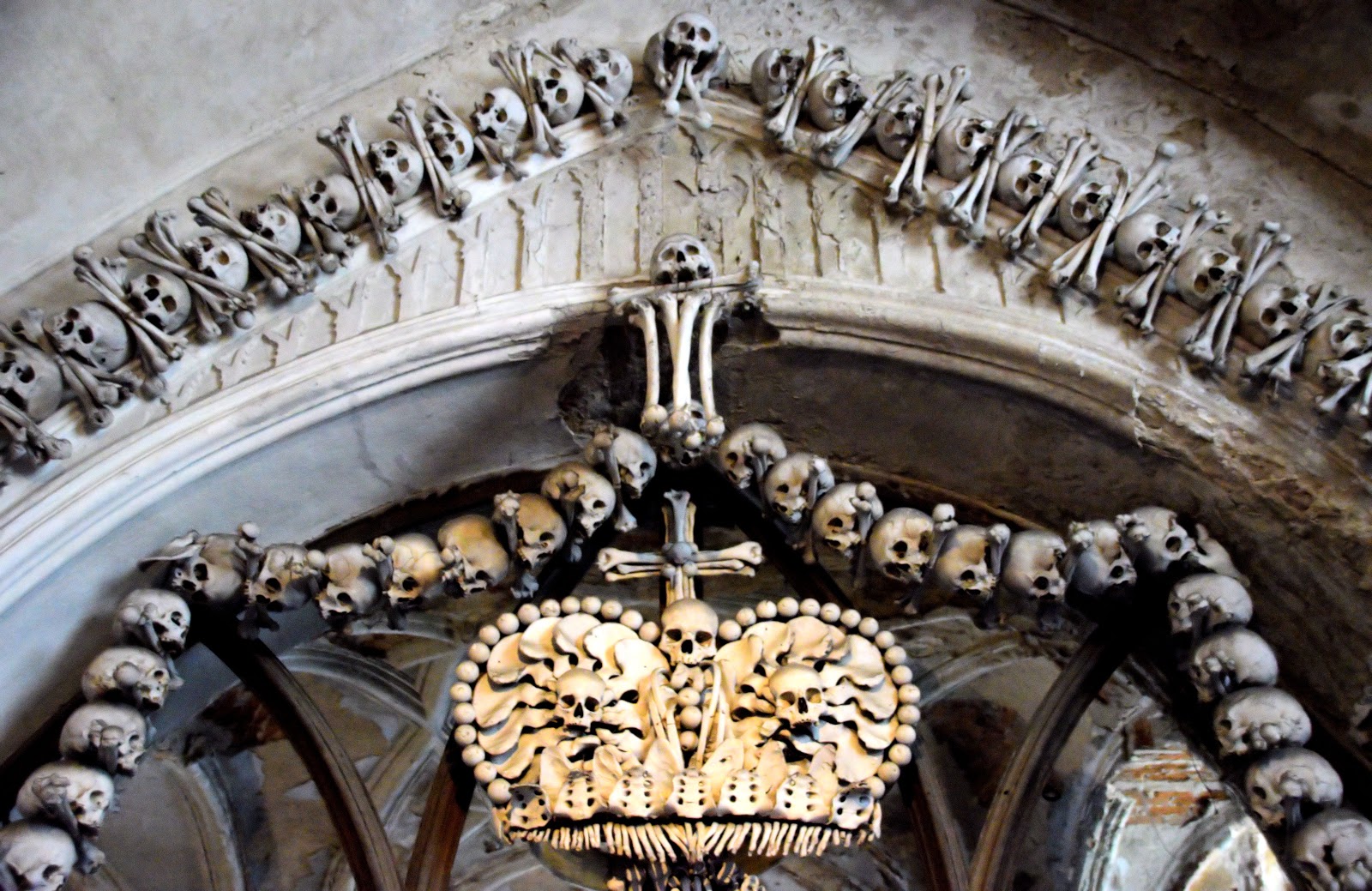


One of the many iconic decorations in the Ossuary is, the Swarchenzbarg coat of arms. Made up of pelvises, skeletal fingers, skull bones, and skeletal arms. A crow made of bones was crafted to be poking out the eye of a skull. This coat of arms is designed to dedicate the Noble German family. ‘Road Unraveled’ investigated and toured the Ossuary, and also said it to be, “signs of trauma that was likely incurred during a war. It’s startling, creepy, and beautiful all at once.”


Work Cited:
“The Sedlec Ossuary.” The Sedlec Ossuary Church of Bones. https://sedlecossuary.com/. 2019.

Christine Blau. “Visit The Creepy Bone Church of Czech Republic.” National Geographic. https://www.nationalgeographic.com/travel/destinations/europe/czech-republic/things-to-see-bone-church-sedlec-ossuary/. 26 October 2017.

Stephanie Hubka. “Sedlec Ossuary: Visiting the Bone Church of Kutna Hora.” Road Unraveled. https://www.roadunraveled.com/blog/bone-church-sedlec-ossuary-kutna-hora/. 2019.

Link for further research:
http://www.outsideprague.com/kutna_hora/bone_church.html 
The link above gives a brief description to the Sedlec Ossuary and presents a video of it as well. Also, Stories of hauntings occurring. 

https://www.youtube.com/watch?v=6wMyv-JOWb8
The link above is a video of the Sedlec Ossuary visited by some tourist. Each scene captures a portion of the Ossuary and shows the decorations inside.

https://www.timetravelturtle.com/sedlec-ossuary-bone-church-kutna-hora-czech-republic/
The link above is a historical summary of the Sedlec Ossuary from 1278 until present time. 


Tuesday, October 30, 2012

Sedlec Ossuary: Church of Bones

Author: Loring Girardeau

Photo by Sony of the view outside of the Sedlec Ossuary.

The Sedlec Ossuary is a chapel that is beneath a Catholic church called the Cemetery Church of All Saints and is located in Kutna Hora, Czech Republic. It is not just an ordinary chapel, though; it is a chapel decorated in human bones. Sedlec became famous in the 13th century when an abbot came from the holy city of Jerusalem and sprinkled some of its holy soil in the graveyard of what was, at the time, a monastery that existed before the church (“The Cemetery”). As a result, many wealthy people from around Central Europe desired to be buried in this cemetery. When the plague struck Europe, demanding many graves, the bones of the deceased began to overload the graveyard (“The Cemetery”). When the church and chapel were built in the 1400s, many of the bones were moved to the chapel beneath the church, becoming an ossuary for the town. When a noble family, known as the Schwarzenbergs, purchased the church in 1870, they hired a woodcarver, Frantisek Rint, to do something with the abandoned bones (Dunford, et al).  He then used the 40,000 bones in the chapel to create the masterpiece of the Sedlec Ossuary that sits in Kutna Hora today.
Photo from flickr of inside the Sedlec Ossuary.

Also referred to as the Church of Bones, the Sedlec Ossuary has many pieces of art made from the human bones.  There is a chandelier located in the center of the church that contains at least one of every bone in the human body (Lawson and Rufus). There are also pyramids of bones located in each corner of the chapel, made of leg bones and skulls, and there is a Schwarzenberg coat of arms, in honor of the Schwarzenberg family, that is made of pelvises, finger bones, skulls, and arm bones. Other decorations include “long streamers and festoons of ribs, vertebrae and tibias…a “fountain” of ribs gushing from a hole in the top of a cranium, or a “bird” made of a scapula and a hand” (Lawson and Rufus).

 Schwarzenberg coat of arms and the chandelier
containing every bone in the human body (Zimmer).

 According to Kevin Orlin Johnson’s Why Do Catholics Do That?, relics (parts of the body of a saint) are used to decorate sections of the church, such as the altar, as a way to honor the martyrs and keep them in the prayers of the people (204). In fact, altars of all Catholic churches must be decorated with some relics in order for the church to be considered holy (Johnson 205). In 1870 Frantisek Rint went far beyond the minimum in decorating this chapel with bones, and it has turned the chapel into one of the most spectacular ossuaries in the world.
Frantisek Rint’s signature signed in bones inside Sedlec Ossuary with pyramid of bones in background (Necromancer).


Works Cited:
Dunford, Lisa, Brett Atkinson and Neil Wilson. “Sedlec Ossuary.” Czech & Slovak Republics. Lonely Planet, 1 Apr. 2007. Web. 16 Oct. 2012.
Johnson, Kevin Orlin. “Relics.” Why Do Catholics Do That? New York: Ballantine Books, 1994. 203-207. Print.
Lawson, Kristan and Anneli Rufus. “Sedlec.” Weird Europe: A Guide to Bizarre, Macabre, and Just Plain Weird Sights. Macmillan, 12 Jun. 1999. Web. 16 Oct. 2012.
mr. nightshade. “Sedlec Ossuary (Kostnice) in Kutna Hora.” Photograph. flickr. Yahoo! Inc., 12 July 2010. Web. 26 Oct. 2012.
Necromancer. “Sedlec Ossuary, chapel of the skeletons.” Photograph. Socialphy. 25 June 2012. Web. 26 Oct. 2012.
Sony. “9. Sedlec Ossuary.” Photograph. Sony Pngst. 6 Nov. 2010. Web. 26 Oct. 2012.
“The Cemetery Church of All Saints with the Ossuary.” Kutna Hora Sedlec. 2012. Web. 26 Oct. 2012.
Zimmer, Lori. “Sedlec Ossuary.” Photograph. Inhabitat. Inhabitat.com, 29 Oct. 2011. Web. 26 Oct. 2012.

For further research:

“7 Wonders of the (Un)Dead World: Global Ossuaries”
Describes seven ossuaries, including the Sedlec Ossuary, located throughout Europe.

“Articulating Bones: An Epilogue”
Describes the bone art in different ossuaries and how they portray death and its meaning.

A Walk in the Ossuary in Sedlec
Contains videos and photos involving the Sedlec Ossuary.