Showing posts with label creature. Show all posts

Wednesday, December 11, 2024

Fur-Bearing Trout

 Author: CrazyTheroiest0095


All over the world from Montana to Canada many people and fishermen know about the

urban legend myth about the fur-bearing trout. The fur-bearing is a creature that grows a thick

coat of fur to keep itself warm in cold waters. According to legends, the fur-bearing trout was

first encountered by Europeans when the Scottish settlers emigrated to Canada during the

seventeenth century.


The very rare fur-bearing trout is in Canada and some parts of the U.S. In the video, it says

that even though there is no real evidence of the fur-bearing trout, one article talks about how

you can ripe away the fur in one piece and use it for commercial purposes and you can also

eat it if you want to.

The Fur-Bearing Trout

This article talks about how in Vermont’s Northeast Kingdom, the fur-bearing trout come out

in the spring and warmer weather but if you try to catch it. It will be extremely hard because

it’s a myth that has been passed down throughout generations. There have been different

stories about the origins of the fur-bearing trout. In the article it says, “No matter how the

story behind the fur-bearing trout came to life, the one thing that is certain, is that the myth

still lives on, and probably will for decades to come.”

The fur-bearing trout is a creature that many people think is a myth or real. It is purportedly

found in the Arkansas River, northern North America, and Iceland. The tall tale about the furbearing

trout is that the waters of lakes and rivers in the area are so cold that they evolved a

thick coat of fur to maintain their body heat. The Saprolegnia will sometimes infect fish

which causes tufts of fur-like growth to appear on the body. A heavy infection will result in

fish death, and as the fungus continues to grow afterward, dead fish that are largely covered

in white fur can be found washed ashore. (https://en.wikipedia.org/wiki/Fur-bearing_trout)


Works cited:

“The Fur-Bearing Trout”, Montana Wildlife, May 1929.

http://www.furbearingtrout.com/montanawildlife.html.

“The Fur-Bearing Trout”, Quickfire Cryptids, July 2, 2023, YouTube.

https://www.youtube.com/watch?v=nO1paSJWobI

“The Fur-Bearing Trout”, Quickfire Cryptids, July 2, 2023, YouTube.

https://www.youtube.com/watch?v=nO1paSJWobI.

“Discover the Origin of Lake Memphremagog’s Fur Bearing Trout”, William Alexander and

Scott Wheeler, Vermonter.com. https://www.vermonter.com/fur-bearing-trout/.

“Fur-bearing Trout” Wikipedia.com https://en.wikipedia.org/wiki/Fur-bearing_trout

Further Research: 

“The fur-bearing Trout” Mythcrafts, June 15, 2017. https://mythcrafts.com/2017/06/15/the-furbearing-

trout/. The fur-bearing trout is one of the rare fish creatures that has a long history in

folkloric with rabbit fur attached to it.

The Fur-Bearing Trout of Lake Superior” Paul Lundgren, Nov 05, 2022.

Perfectduluthday.com. https://www.perfectduluthday.com/2022/11/05/the-fur-bearing-troutof-

lake-superior/. This article talks about the fur-bearing trout is a very rare species of fish. It

was caught while trolling in Lake Superior off Gros Cap, near Sault Ste. Marie, District of

Algoma.

“Legend of Ross C. Jobe furry trout lives on in Scotland”, Sootoday.com.

https://www.sootoday.com/columns/remember-this/legend-of-ross-c-jobes-furry-trout-liveson-

in-scotland-3573128. In this article talks about how the legend Ross C. Jobe caught the

very rare fur-bearing trout while trolling in a lake. The trout was mounted by Ross and

arrived at the museum by way of a donation by a returning tourist believing it was real.


Friday, December 15, 2023

Changeling


Author: Dallas Hitt


When you think of fairies , you probably think of this nice and sweet little creatures with wings and an little wand, that has glitter on it. You probably don’t think of little thieves that still children. That is not the case with the Folklore creatures, Changelings. Changelings are fairies that were left in the place of the child that the fairies stole from the humans.


Children would be taken and replaced with a change for one of several reasons. The first reason is that it would be taken is for the child to act as a servant to the fairies. Another reason the fairies would take the child was so that the change could get the love from the humans like a human child, and the last reason would be so that the fairies could get revenge on the humans for something. Sometimes the fairies would replace the child with an elderly fairy so that it could live out the rest of its life in the care of the humans. People would notice their baby become ill or become not bale to properly function and they would assume it had been “fairy struck.” The people would say the children had been replaced by a changeling and they abandoned them or sometimes even killed them.

There were a few ways to identify if your child was a changeling. Irish legends say that changelings might look sick and not grow to full size like normal humans. Changelings also had a very large apatite and would eat a lot more food than a normal human child.

One theory that folklorist and historians studied was that people would substitute their children for changelings during raids and attacks on their villages in thoughts that they might be saving their children by doing this. Another theory about the origin of the changeling was a lot different than the other. Some people believe that changelings came from a very dark part of the mind from pre-industrial Europe. If a family felt that they wouldn’t be able to care for their child, especially if the child that had a disability or had an illness or deformity, it was easier for them to lose their child thinking it had just been talking by fairies, rather than believing they were just letting their child die. Some physical characteristics that a changeling had that you might be able to notice was they had long teeth and scraggly hair.

Changelings would continue to appear again and again in folklore in Europe. Doctors say this list of diseases from today’s time such as: cystic fibrosis, Down Syndrome, spina bifida, PKU, Williams syndrome, Hunter syndrome, cerebral palsy, autism, progeria, Hurler syndrome, and Prader-Willi Syndrome, match the description of what changelings might have been like. Now adays in the modern world no one would really believe in changelings, but doctors say that a lot of autistic children might have been labeled as changelings in that time.

Works cited:

Https://Static.Wikia.Nocookie.Net/Mythology/Images/2/29/Changeling2-800x0-c-Default.Jpg/Revision/Latest?Cb=20180713191804. Accessed 1 Nov. 2023. 

Dimri , Bipin. “Your Child Is Not Your Own? The Horrific Tales of Medieval Changelings.” Historic Mysteries , 6 Oct. 2021, www.historicmysteries.com/changeling/. 

 Post, Irish. “Exploring Irish Mythology: Changelings.” The Irish Post, The Irish Post, 22 Dec. 2021, www.irishpost.com/life-style/exploring-the-irish-mythology-changelings-170347.

Links for Further Research:

1.     Encyclopedia Mythologica
https://encyclopediamythologica.com/changeling
This website will tell you about different myths from other parts of the world about changelings.

2.      Wikipedia
https://en.wikipedia.org/wiki/Changeling
This website will just give you a very good overview of changelings if you just really want to find out more about them.

3.     BMJ Journals
 https://adc.bmj.com/content/90/3/271#
This website will tell you more about how diseases were in involved in changelings like autism.

Friday, November 4, 2022

The Mysterious Bunyip: Real or Fake?

 Author: Cole Grice


Down in the swamps and lagoons of Australia, a creature called a Bunyip prowls the land and water hunting for human prey, especially women and children. Although there are many stories about this terrifying creature, does it actually exist or is it just a hoax?  

As described by Bernadette Giacomazzo in “Meet The Bunyip, The Monstrous Cryptid Said To Inhabit Australia’s Swamps," the Bunyip has black fur, a round head, a long neck, sharp teeth, and a body type that is similar to an ox, hippopotamus, or seal. This creature is allegedly between five and fifteen feet long in size. The Bunyip supposedly made load, roaring noises while waiting to devour human beings. Its roars can echo across all of Australia. The article also states that the first sighting of the creature occurred in New South Wales in the year of 1818, when two explorers named Hamilton Hume and James Meehan discovered a large set of strange bones by a lakeshore. Most people believed the bones were from a deceased hippopotamus.

Although the Bunyip’s appearance has not been reported in current time, it began to become popular in the nineteenth century. According to an article called, "18 Facts About The Bunyip, A Cryptic From The Swamps Of Australia," by January Nelson, the most frequent reports of the mythical creature happened throughout the years of the 1840s and 1850s. During these years, the actual term, “The Bunyip,” was given to the creature. The word, “Bunyip,” stands for ‘devil’ or ‘evil spirit’ (Fae). It was given this name as it attacked people which caused a lot of fear among the communities in Australia. 

The Bunyip still plays a large role in Australia’s culture today. The creature may just be a myth in a folktale, but it continues to thrive in modern time Australia. As talked about by Gabriel Berreteaga in “A Fantastic Rendition and Jubilee of the Bunyip in Australia,” the Bunyip is seen in many children’s books and films. It is also displayed around the country as statues. This article also acknowledge the Bunyip Park, which is located in southern Australia. The park includes the Button Grass Nature Trail and educates children about the Bunyip through interactive story books. 

Overall, it is only up to you whether you want to believe in this man-eating creature. Does it wait through the night for people or was it made up to scare us? Will we ever truly know if it is real or fake?

Works cited: 

Berreteaga, Gabriel. “A Fantastic Rendition and Jubilee of the Bunyip in Australia.” YOAIR Blog. October 3, 2022, https://www.yoair.com/blog/a-fantastic-rendition-and-jubilee-of-the-bunyip-in-australia/

Fae, Kota. “Aboriginal Lore: The Bunyip (Devil Spirit of Australia).” Amino. June, 19, 2018, https://aminoapps.com/c/thewitchescircle/page/blog/aboriginal-lore-the-bunyip-devil-spirit-of-australia/8qv1_pjSmuW5YWz1WpgLErK2XMR851GGP 

Giacomazzo, Bernadette. “Meet The Bunyip, The Monstrous Cryptid Said To Inhabit Australia’s Swamps." ATI. January 25, 2022, https://allthatsinteresting.com/bunyip

Macfarlane, J. Bunyip. 1890. Photograph. “The Bunyip,” Wikipedia. https://upload.wikimedia.org/wikipedia/commons/thumb/a/a8/Bunyip_1890.jpg/440px-Bunyip_1890.jpg

Nelson, January.  “18 Facts About The Bunyip, A Cryptic From The Swamps Of Australia." Thought Catalog. March 27, 2021, https://thoughtcatalog.com/january-nelson/2018/08/bunyip/

 Links for further research:

       New Idea Magazine’s Aussie Woman Tells: My Yowie Terror

 https://www.newidea.com.au/aussie-woman-tells-my-yowie-terror 

This article by Danielle K. presents a phone interview with a woman who had a personal encounter with a creature in which she thinks is the Yowie (also known as the Bunyip).

    The Age: Rediscovered Rock Art Reveals an Ancient Monster

 https://www.theage.com.au/national/victoria/rediscovered-rock-art-reveals-an-ancient-monster-20190106-p50pu1.html?fbclid=IwAR3HYSnpht9Fp1Q5Yz--cBykB8ZVv1jOAOOyGzAoUc1lhlvxAVD8_YeRLLM

 This article by Joe Hinchliffe, tells the readers about a Bunyip drawing in a cave that can be dated back to many years ago.

      Project Gutenberg License: The Brown Fairy Book

https://www.gutenberg.org/cache/epub/3282/pg3282-images.htmink2H_4_0006

This book, written by a Scottish novelist named Andrew Lang, tells a story about young men who had an interaction with a Bunyip while on a camping trip.


Thursday, May 9, 2019

Chupacabra, Fact or Fiction?

Author: Joshua Sunderman

A picture of A Chupacabra
Chupacabra, A mass-hysteria creature or real-life horror? As the Chupacabra is a myth that first started in Puerto Rico. Where a farmer had reported his cattle dead by means of their blood being sucked dry. Soon reports of the Chupacabra began appearing all over the North and South America. Where it was unknown exactly what the creature looked-like that cause a feat but many theories it to look like this. A creature, according to “Tracking the Chupacabra” by Benjamin Radford, that has many variations of descriptions leaving it to be cryptid (unidentifiable animal). One description of a Chupacabra being covered in glossy matted hair and has a feral face with long limbs that end in massive claws. Making it able to transverse any terrain at a huge distance and some say the Chupacabra even has wings. Most often though, the creature is described as having red eyes, feathery-like spikes going down its spine.

A Chupacabra with wings by Cristart (2001)
Chupacabra ways of killing its victims could even be described as a vampire as it meets all the classifications to be classified as a vampire. While the stereotypical vampire is more like Count Dracula, a tall, thin, pale, white-haired and or bald man with fangs that can transform into a bat. However, as informed by Benjamin Radford the Greeks described vampires as malevolent undead creatures that stalked the living, bring death and disease. Vampires would also puncture two holes into the victim’s neck as they suck their blood dry and that is exactly what victims of the Chupacabra were found dead two punctured holes in the neck bleed dry. Which scientist examined the puncture wounds and they would be that of canine’s teeth.

A Chupacabra being examined
Upon closer inspection of the Chupacabra lead scientist to logically conclude that it is actually a canine, typically a coyote or a dog, with a disease called mange. Where the hair of the creature is at a loss leaving them bare-skin and more in a weaken state. Which the reason it is so close vampires is that it is the canine’s instincts is to go straight for the neck of its prey. Then the canine would go off and kill another animal for food or sport while the victim dies from suffocation, internal hemorrhaging, and or infection (Benjamin Radford).

So, while the Chupacabra may not have its extreme alien-like features it is most certainly a real creature just in more of a disease that is affecting a canine.

Resource links:

"The Chupacabra & Bigfoot" , Scholastic Scope. 2/14/2011, Vol. 59 Issue 10, p16-16, 1p, Academic Search Premier, http://ezproxy.usca.edu:2048/login?url=http://search.ebscohost.com/login.aspx?direct=true&db=aph&AN=58030972&site=ehost-live&scope=site.

Lopez, Lalo “Media-Fueled Chupacabra-Mania Raises ‘Fact or Fiction’ Hysteria.”, Hispanic. Aug1996, Vol. 9 Issue 8, p12. 2p. 1 Color Photograph. Academic Search Premier, http://ezproxy.usca.edu:2048/login?url=http://search.ebscohost.com/login.aspx?direct=true&db=aph&AN=9608164065&site=ehost-live&scope=site

“Not a Monster.”, Outdoor Life. Feb2005, Vol. 212 Issue 2, p21-21. 1/7p. 1 Color Photograph, Academic Search Premier, http://ezproxy.usca.edu:2048/login?url=http://search.ebscohost.com/login.aspx?direct=true&db=aph&AN=15632026&site=ehost-live&scope=site

Further Research:

http://www.bbc.com/earth/story/20161109-the-truth-about-a-strange-blood-sucking-monster
A local article that goes into further detail about the Chupacabra explain this monstrous story and even talks about the author who wrote “Tracking the Chupacabra” Benjamin Radford and talks about his research.

https://www.amazon.com/dp/B004XOGILY/ref=dp-kindle-redirect?_encoding=UTF8&btkr=1
Benjamin Radford is someone who has been investigating this mysterious and unusual phenomena for over a decade, and in this chapter “A Brief History of Vampires” it gives off a summary of how there are many vampires in the world ranging from the European, to African, to Latin American.

https://study.com/academy/lesson/quotes-about-count-dracula.html
This is for information for about Count Dracula and their appearance along with some more explanation about his powers he can do.

Friday, April 12, 2019

The Truth of Mothman

Author: Rhonda Moxley


In a dark town along the Ohio River in Point Pleasant West Virginia. On November 12, 1966 two couples both recently married saw a tall, figure in front of them. The creature had big red eyes and wings. They tried to get away but the creature could fly 105 mph. What is this creature you ask? He is very known as the mothman. Nobody has spoken up about see this creature until now. After news has got out more people of the town has spoken up. Over the next thirteen months they had more than 100 reports saying they saw “the bird” or “big bird” also known as mothman. Many didn’t want to say anything because they didn’t want t get called crazy.


A woman skeptical after hearing this decides to go the “TNT” the area where the couple saw him, to see if she can see him for herself. She was carrying her child the car and saw a tall like man with big wings outside her car. She was too scared to drive after that. On December 15,1967 the Silver Bridge  collapsed killing 46 people. Many come to think that mothman came to warning of the collapse. Later they came out with a film called “The Mothman Prophecies” and it orientated from mothman. The movie aired in 2002 with Richard Gere staring as Klein the main person in the movie. Klein wakes up in Point Pleasant with no idea how he got there, he then sees a creature his wife saw before she passed.

Word Cited: 
Ansen, David. “Bugged Out.” Newsweek, vol. 139, no. 4, Jan. 2002, p. 60. Discuss, ezproxy.usca.edu:2048

Grunge. “The Untold Truth of Mothman” Youtube, 4 Aug. 2017. https://www.youtube.com/watch?v=PH4fEGjdQm8

“Mothman Picture.” Brittany White. “What The Recent Chicago Mothman Sightings Mean For The Future (And Theories About What The Mothman Really Is),” Your Tango, 1 Feb. 2018. https://www.yourtango.com/sites/default/files/styles/header_slider/public/image_blog/mothmanvice.jpg?itok=JfayD83E

Powell, Dennis E. “Mothman Lives! Or Lived! Maybe?!” Athens News, 23 Oct. 2017, pp. 1–2. Disscus, search.ebscohost.com/login.aspx?direct=true&db=n5h&AN=125838997&authtype=cpid.

Links for further research: 
https://www.youtube.com/watch?v=bXcpwJbXT7o 
This link will show you the trailer for the movie “The Mothman Prophecies”

https://www.mothmanfestival.com/
This link shows you information about the festival done for Mothman every year.

Wednesday, November 11, 2015

The “Mysterious” Fiji Mermaid

Trevor Dent
 
The Art of Juan Cabana.
In today’s society, everyone has their opinions on mermaids and whether they are real or not. I believe mermaids are real. Mermaids have been around for as long as people can remember. Earth is over 70% water and about 95% of the oceans remain unexplored. Men back then have claimed to see mermaids and there have been multiple stories written and also movies about mermaids. They are believed, centuries ago to roam the seas and lure sailors into shipwrecks, and off the coast into rocky shoals. Mermaids are often associated with bad luck and misfortune. By definition, a mermaid is a beautiful woman, with long hair, and the lower body of a fish. Homer’s Odyssey tells the story of an encounter of a siren and how they were tortured by their sweet sounds. Another story is a young boy from Scotland claimed to have killed a mermaid in 1830 by throwing rocks of it. It definitely looked like a mermaid they said, but there hasn’t been real evidence of it. There are many more legends and many historical claims of MERMAID SIGHTINGS  and it leaves people with many questions, but until we see  better and more pictures and videos, mermaids will continue to be a myth.
           

Most people don’t think of certain mermaids, or a particular type when talking about them, but there once was a hoax about the legendary Fiji Mermaid by the famous known P.T Barnum. The FIJI MERMAID was an object composed of the upper body of a monkey sewed onto the lower body of a fish. This hoax is became a worldwide topic thanks to the legendary showman P.T. Barnum who was famous for these types of things. The Fiji Mermaid came into Barnum’s possession in 1842 via his business counterpart Moses Kimball and was reportedly found on the Fiji Islands in the South Pacific. Barnum would go ahead and put the mermaid up for display in his Boston Museum in the summer of 1842.  Barnum would lead people to believe that this was a true thing and would so for a very long time until his museum was burned down by a fire in 1865 and people to this day still question whether that was real or not.  P.T. Barnum even explains himself why he did what he did and his reason behind it in his own autobiography. He says the Fiji Mermaid first came to him from Moses Kimball in 1842 and it was made by fisherman. He never realized its value and at that time, it was a great time to examine the mermaid. Barnum claims that was the easiest part of the experiment. ‘How to modify general incredulity in the existence of mermaids, so far as to awaken curiosity to see and examine the specimen, was now the all-important question.’ (Barnum)
           

The Peabody Museum's "Feejee Mermaid" (photographed in 1998).

The Fiji Mermaid was actually thought to be made by hand by fisherman in Southeast Asia and sold for a profit to local stores. The first ever mermaid was brought to London by Captain Samuel Barrett. Even though it was handcrafted, this lead people to believe if there was a real thing and if so, why was it made.

Works Cited:
Barnum on the FeJee Mermaid, The Life of P. T. Barnum, Written by Himself, 1855. American Social History Productions, Inc., 1855. Web. 8 Oct. 2015.


""The Little Mermaid?"" The Harvard University Gazette. Harvard College, 17 Oct. 1997. Web.

"Legend of the Fiji Mermaid." The World Is a Myserious Place. Awesome Inc. Template. 1 Oct. 2013. Web. 13 Oct. 2015.

"The Incredible Myth Behind the Feejee Mermaid." Scribol. Scribol. Web. 15 Oct. 2015.

Links for further research:
http://hoaxes.org/archive/permalink/the_feejee_mermaid
The article above gives you a good overview of the Fiji Mermaid, and also tells everyone who was involved in it.

Monday, November 9, 2015

Slender Man

Ryan Wells


    Since 2009, Slender Man has been out in the public across the world, and is a topic of discussion.  In that year, his existence started on a Photoshop contest blog, Something Awful (NY Times). It contained a picture of a well-dressed man, in black suit and tie, hovering over a young child.  And it is said that he closely follows children. Whenever out in the woods at night, people keep their eyes open for this horrifying creature.  But according to his legend, that is the last thing you would want to do.  This is because he would put you in a trance like state, and lure you in the woods to your death (Creepy Pasta).


His existence has been popular since the thread, but even more so since June of 2014, when he was associated with a stabbing of 13 year old girl.  Two other pre teens, in Waukesha, Wisconsin, felt that they were obligated to kill her for “Slender Man”.  Even though they stabbed the girl 19 times, she ended up surviving and even making it to the court appearance. But, why do this for Slender Man?  In the interrogation tapes, they are even saying that they saw “Slender” while exiting the woods.  What gave them the reason to believe that they were doing right, by committing such an awful crime?  Maybe, it is the effect that people have on everything in society.  Making everything bigger than it actually is to start with.
 

Even though he is said to have been born on 2009, his appearance ties him in with other legends, of different countries.  For example, “The Dark Man” in Scotland or the “Tall Man” in Germany (Creepy Pasta).  Egyptian Hieroglyphics also have presentations of what are thought to be him. Different markings of all kinds of cultures have something that is comparatively similar.
After all of these “attacks”, they have even made video games based off of his appearance.  In these action-packed games, you walk around looking for papers, with a flashlight.  Eventually, if you come up face to face with Slender Man, and don’t get all of the papers, you meet your demise.  So it is safe to say, society makes everything bigger.


Works Cited:

Dewey, Caitlyn. “The complete, terrifying history of ‘Slender Man,’ the Internet meme that compelled two 12-year-olds to stab their friend.”  Washingtonpost.com Washington Post, 3 June 2014. Web. 7 Oct. 2015.

Manjoo, Farhood. “ ‘Slender Man’ story and the New Urban Legends.” Nytimes.com. NY Times, 9 July 2014. Web. 12 Oct. 2015.

“The Slender  Man.” Creepypasta.com. Creepy Pasta. Web. 12 Oct. 2015


Links for Further Research:

“Slender Man.” Slenderman.com. Slender Man. Web. 12 Oct. 2015
http://slenderman.com/
This link goes to the game in which slender man is in.  The downloadable site.

“Who is Slender Man?” YouTube. YouTube, 2 Feb. 2015. Web. 12 Oct. 2015.
https://www.youtube.com/watch?v=bxtIyzWrFyM
This link is a more concrete look at Slender Man, in an ABC 20/20 setting.

Goldstein, Jack. 10 Amazing Slender Man Stories. Andrews UK Limited, 2013.Google Book Search. Web. 12 Oct. 2015. 
https://books.google.com/books?isbn=1783331828
This link has 10 stories of Slender Man.  Also, biblical views as a whole.


Saturday, November 2, 2013

Bigfoot

Author: Avery Deas


"Bigfoot." Chambers Dictionary of the Unexplained. London: Chambers Harrap, 2007. Credo Reference. Web. 17 October 2013.  This source gives good information about some people who has had an encounter with Bigfoot. The writer intends to persuade the reader to believe that Bigfoot is real. The source is targeting people who believe in bigfoot. This is written to let the world no bout the encounters some people had with Bigfoot. I chose this source because it tells about peoples encounter with bigfoot. There are no pictures but it is well organized. This source has real people talking about their encounter with bigfoot, which would provide good information for my research.


Martin, Linda Jo. Marble Mountain Wilderness Bigfoot Sightings. Bigfoot Sightings. LJ Mattin Web, 23 July 2012. Web 16 oct. 2013. This source gives good information on where Bigfoot was sighted or could be found. It also shows videos of the beast. The source intends to give  real evidence of Bigfoot in the wild and to show where it could be found. The writer is targeting nonbelievers by showing them video evidence of the creator. I chose this source because it showed the location of where bigfoot was seen and videos of the creator. This source is different because it actually give s proof. I hope to use the videos to improve my research. 


"LEGENDS AND OTHER TRUTHS." The Greenwood Encyclopedia of American Regional Cultures: The Pacific Region. Santa Barbara: ABC-CLIO, 2004. Credo Reference. Web. 17 October 2013. This source talks about the terrain and territory Bigfoot is most likely to live. The website is not to influence the reader but to give the reader knowledge on the type of habitat Bigfoot would live in. The source is for everyone to know. It does not target a particular group of people. I chose this source because for those who do believe in Bigfoot would love to know where to find it. With this source I hope to gain more evidence.


Pavone Food. Jack Link's "Messin' with Sasquatch" is advertainment gold. Pavone Food and Beverage. Pavone, Inc, 30 May 2013. This source shows bigfoot in commercials that we all watch. It does not Influence the reader but it gets everyone's attention by using  the TV network. This source is to entertain the readers. I chose this source because it uses funny videos to capture the reader's attention. Using this source well help me get the audience attention and not bore them with just facts but can also entertain them with funny videos.

"Yeti." The Crystal Reference Encyclopedia. West Chiltington: Crystal Semantics, 2005. Credo Reference. Web. 18 October 2013. This source gives me a another name for Bigfoot known as the yeti. It gives the reader a different name for the beast. The source targets everyone. I chose this source to show that bigfoot is none if many different names.

Shapeshifting, Weird but Very Cool

Author: Brittany Pressley


Added to MonsterWiki by realwaba

In fiction shapeshifting is the ability of a being to physically transform into another form or being, either as an creature. For those who don't really know what shapeshifting is it more like you can be normal but you can turn into anything you please, so if you wanted to become a animal you could. When most people think of shapeshifting they think evil but in reality that isn't true. there are seriously books on the topic but i only found two in our library . 
Reptilian Shape Shifter Photo Hoax
by Stephen Wagner, 2008

"Witches Werewolves and Fairies" and "they suck, They bite, they EAT, They kill." Both books talk about creatures and normal people turning into them. Just by the title you can tell that they are all shapeshifters. In most books you read they have vampires and wolves as shapeshifters are well known  They are what some might call black magic, but in most eyes they are far from that. shapeshifters are very cool and interesting

Works Cited:
Bodart, Joni Richards. They suck, they bite, they eat, they kill: The psychological meaning of
             supernatural monsters in young adult fiction. Lanham, MD: Scarecrow P, 2012.

Lecouteux, Claude. Witches, werewolves, and fairies: Shapeshifters and astral doubles in the
            Middle Ages. Rochester, VT: Inner Traditions, 2003.

Links for Further Research:
Teen Wolf: Shapeshifting
It talks about how at a full moon the true wolf comes out of a shapeshifter.

Shapeshifters
This websites shows you a lot of different kind of shapeshifting and you can click and learn about the different ones.

Twilight Wiki: Shapeshifting
Twiliight is a show about people fighting and protecting their land. They turn into wolves and Vampiries. it teaches you why they turn into them.

The Beast of Bray Road

Author: Paige Fulmer

Image from Fox News
The Beast of Bray road is said to be a hairy humanoid with canine features, much like a Werewolf.  Although in some places it was labeled as Bigfoot.  Scientist labeled it as Bigfoot because they wanted to avoid dealing with absurdities that people would be frightened by it more than calling it a werewolf.  The Beast of Bray Road  is the most famous modern American werewolf.  The Beast is out of the ordinary but nothing like an actual werewolf.  The Beast is sort of that of two different creatures in the same place at the same time but only seeing one.  


Burrunjor

Author: Brandon Sharpe


Many stories have been passed down through the years about a giant reptilian carnivore called the “Burrunjor.”  This is a huge walking reptile, which roams in Australia, looking for both humans and animals for food.  Some of the “Burrunjor’s” distinct characteristics, such as its short arms and its huge three-toed track, relate it to other dinosaurs like the Tyrannosaurus and the Megalania Prisca.  Another characteristic the “Burrunjor” had was a bipedal stance, which allowed the creature to run a great distance with it.  This reptile would belong to a group of dinosaurs that became extinct many years ago called the Theropods.
            The Aboriginal tribe of Australia, here “long before the coming of White Men,” believed these monsters entered came from the past though “time windows” (The Cryptozoologist).  Other views that the tribe may have on “the creation of the world” are known as the “Dreamtime” (The Cryptozoologist).  This theory could also be used to explain mysteries of other extinct animals that have been seen in other places, but have never been captured.  This tribe has passed down information of this reptile by cave drawings and oral tradition.  Because it was simply passed down orally form one generation to the next, who knows where there story could have changed.  The stories included such tales as farmers reporting their cattle as missing or being half-eaten.  Loud rumbling sounds in the distant and even personal encounters with the Burrunjor are other stories the Aboriginal tribe members can tell.  One story specifically was told by the “part-Aboriginal tracker” Johnny Mathews.  Mathews said he saw “a 25-foot tall” creature described as a Burrunjor “moving through scrub…one day in 1961” (The Cryptozoologist). 
            There are many other stories and claims that have been told regarding the Burrunjor.  One certain well-known account is from the book Out of the Dreamtime – The Search from Australasia’s Unknown Animals written by Rex and Heather Gilroy.  The Gilroy’s write about a man named Bryan Clark who was tending to a group of cattle, but got lost out in the woods.  Little to Clark’s knowledge a policeman and two Aboriginal trackers set out to find him.  Once darkness fell the three men decided they needed to set up camp, which so happened to be in the area around the “Burrunjor’s land.”  Much to the Aboriginals’ dismay the men tried to catch some sleep.  Soon the policeman’s sleep was disturbed by the yelling and screaming of the Aboriginals and he finally realized the ground was shaking.  The men quickly got their things together and ran out of the woods, never looking back.  Later, the policeman reportedly told Clark that if he ever found himself in that situation again, it was every man to his own.  No one wanted to go back in there in fear of the terrible sounds thought to come from the Burrunjor. 


Image of the Burrunjor from SyFy's Destination Truth
Works Cited
KASAI REX, BURRUNJOR, AND MINI-T-REX: EVIDENCE OF SURVIVING CARNIVOROUS DINOSAURS? PART 2.” The Cryptozoologist. The Cryptozoologist, 30 May 2012. Web. 17 Oct 2013.

For Further Research:
Syfy
This website gives a little bit of background information on the Burrunjor.

Truedinos
The link gives an in-depth analysis of many creatures that are believed to be extinct.  This will give a lot of accounts from the book by Rex and Heather Gilroy that was mentioned earlier.

National Geographic
This link will lead you to website that will give further information on the Aboriginal people, which were one of the first to give claims on the Burrunjor.

Thursday, October 25, 2012

Mokele-Mbembe


Author: Lauren Faircloth

by  Nik Petsev, 2002
Mokele-mbembe is Lingala , and can mean a variety of things. The word is commonly defined as "one that stops the flow of rivers," but can also mean "one who eats the tops of palm trees," "monstrous animal," or even "half-God, half-beast." Mokele-mbembe is also used as a generic term to refer to other animals like Emela-ntouka, Mbielu-mbielu-mbielu, and Nguma-monene. Mokele-mbembe has been described as an animal with a long neck, tail, and rounded shaped tracks with three claws. The closest known animal that has these characteristics is a Sauropod dinosaur. 
The body size of each specimen is said to be somewhere between the size of a hippopotamus and an elephant. Its length is reportedly between 16 to 32 feet (5 to 10 meters). The length of the neck, according to various descriptions, is between 5 to 10 feet (1.6 to 3.3 meters). The length of the tail is somewhere between 5 to 10 feet as well.
             The pygmies, natives of the Likouala Swamp region, report that the essential diet of Mokele-Mbembe consists primarily of the Malombo plant. Since it only eats plants, it is classified as an herbivore. The Malombo plant actually describes two plants: Landolphia mannii and Landolphia owariensis.
Mokele-mbembe lives in the pools and swamps adjacent to the rivers of the Likouala swamp region of The People's Republic of Congo on the continent of Africa. It is said to use the lakes as a crossing path to go from one river to another. Mokele-Mbembe lives underwater most of the time except when it eats or travels to other parts of the swamp. It has been reported that it does not like hippopotamuses and will kill them on sight, though it does not eat them. According to the pygmies, Hippopotamuses cannot be found where Mokele-Mbembe lives.
            Expeditions in search of the mokele-mbembe primarily began in the 1880s. In 1913, a German explorer reported stories of, what the natives called, "Mokele-mbembe," which he had heard while in the Congo. Hearing the reports, a few scientists noticed that the descriptions of the creatures made them sound much like sauropod dinosaurs. Sauropods were the giants of the dinosaurs world, averaging about 70 feet (21 meters) long and standing 12-15 feet (3.7 to 4.8 m) tall at the hips.
In 1932, a British scientist, exploring near the Likouala region where the creatures are said to live, came across some abnormally huge footprints. Later, when he went down one of the rivers in a canoe, he heard strange sounds, but did not see anything. Coincidentally, that same year the world famous zoologist and biologist, Ivan T. Sanderson, along with animal-trader Gerald Russel, were paddling up the Mainyu River in the heart of western Africa when, according to Sanderson's report:
"The most terrifying sound I have ever heard, which sounded like an on-coming earthquake or an exploding, nearby robot, suddenly greeted us from a large underwater cave."
While the water of the river was boiling and foaming directly in front of their canoe, a “darkish, shining lizard-like head” suddenly rose from the dark water. They described the head as nearly the size of the head of a fully grown hippo, which sat on a thick, swan-like neck. The enormous neck was turned towards the two men, and for just a few seconds, although it seemed like an eternity, the monster simply stared at Sanderson and Russel. Mr. Sanderson summed up his thoughts with these words:
"I don't know what we saw, but the animal, the monster, burned itself into my retinas. It looked like something that ought to have been dead millions of years ago. As a scientist, I should have been happy, of course, but this encounter was so frightening, so nasty that I never want to see it again."
 

Works Cited:

Gibbons, William J. "In Search Of the Congo Dinosaur." In Search Of the Congo Dinosaur. ICR, July 2002. Web. 22 Oct. 2012. http://www.icr.org/article/306/

"Lingala." Dictionary.com. Dictionary.com, n.d. Web. 23 Oct. 2012. http://dictionary.reference.com/browse/lingala?s=t.

"Mokele Mbembe!." Skeptic 17.3 (2012): 63. Science Reference Center. Web. 22 Oct. 2012.

Petsev, Nick. "Cryptids - Mokele-mbembe." Cryptozoology.com. N.p., n.d. Web. 20 Oct. 2012. http://www.cryptozoology.com/cryptids/mokele.php.

"Sauropod." Dictionary.com. Dictionary.com, n.d. Web. 23 Oct. 2012. http://dictionary.reference.com/browse/sauropod?o=100505.

Wilford, John Noble. "'Dinosaur' Eludes Six-Week Search in Africa." New York Times (1923-Current file): 1. Dec 10 1981. ProQuest Historical Newspapers: The New York Times (1851-2008). Web. 22 Oct. 2012.


Links for further research:

Mokele-Mbembe: The Living Dinosaur

Articles and information compiled by Scott Norman


Was a Mokele-mbembe killed at Lake Tele?

An account of an encountering with a mokele-mbembe

'Mokele-Mbembe' The Last Dinosaur Documentary Part 1

A documentary of the search for Mokele-Mbembe from
The History Channel


Wednesday, October 24, 2012

Zombies: What's the Fascination?


Author: Olivia Grace Burbage

 Cartoon of a zombie
Zombies. Why are we all so curious about zombies? More fiction than fact, the zombie is, at its barest minimum, the living corpse of a human body. But how can it be a living corpse? If “living” refers to the presence of life and “corpse” refers to the presence of death, how can the two words come together to describe one creature? That is exactly the point. Nothing can be both alive and dead – functioning yet not processing, thinking, or controlling itself – can it?
A zombie is a flesh eating, supposed to be dead human who acts on to its desire for flesh and nothing else. It does not think, remember, or rationalize. To kill a zombie, according to J. Gordon Melton’s The Vampire Book: The Encyclopedia of the Undead, a sharp blow to the head should do it (831). That, of course, is not so simple when the zombie is desperately trying to eat you. They hang out in mobs, which makes destroying them even more difficult, and as far as their concern over keeping up appearances – it doesn’t exist. J. Gordon Melton describes them as decomposing human bodies wearing horrid expressions (831). Their hair isn’t combed, their clothes are tattered, and their bodies, trying desperately to decompose, eventually form gaping holes. I ask again, why are we all so curious about zombies?

Map of Haiti
So where did the zombie come from? Someone’s overactive imagination, perhaps? Actually, the zombie was first born out of Haitian voodoo. Before modern science came to the rescue with its current definition of the death-state – no response, no breathing, no heart-rate, and no brain activity – many people were buried alive. Haiti, with its limited technology and medical knowledge, buried many a live person. So when these allegedly dead humans came back from the dead, the scare must have been tremendous. During the 1980s, an author named Wade Davis encountered this first hand when he traveled to Haiti to perform some research (Hall). He actually met and carried on a conversation with a man who wore a scar on his face from the nail of his coffin. (Hall) Perhaps it was stories like this that led to the birth of the zombie.
Maybe, however, it was the use of a certain drug called tetrodotoxin, discovered in Haiti by ethnobotanists and anthropologists according to research done by Penn State's James Conroy. Tetrodotoxin is a “potent neurotoxin,” taken from the puffer fish. This poison is so deadly that the amount in one fish is enough to kill about thirty people (Conroy). Haitian witchdoctors used this drug, so zombies may have developed through its use. The problem with such a drug being the cause of zombification is that the amount given to a person would have to be so specific that it would shut down their mental processes, almost to the point of a coma, yet not kill them. Author of the book The Zombie Movie Encyclopedia Peter Dendle believes that a few rare times in history this phenomenon may have happened, but not enough to fear the coming of the zombie apocalypse (Conroy).
So, if zombies as we know them are not living bodies returning from a too early burial or the result of this powerful neurotoxin, what are they? Who can define and describe a zombie? Because zombies are mostly the result of overactive imaginations, they are incredibly difficult to define. I may feel confident in my description of a zombie, but someone else may disagree on nearly every point. But on one point, most every expert in the field agrees: zombies are fiction. What they are is not nearly as important as why we let them go to our heads.

Works Cited:
Brand, Anton. “#9403566 – Cartoon of a green zombie hand coming out of the earth.”
Cartoon. 123RF. N.p. 12 Oct. 2012. Web. 22 Oct. 2012.
 Conroy, James. ResearchPennState. The Pennsylvania State University. 29 Oct. 2007.
Web. 18 Oct. 2012.

Engdahl, F. William. “The Fateful Geological Prize Called Haiti.” Map.
Global
Fluxguru. Blogger. Web. Friday, Feb. 4 2011. 22 Oct. 2012.

Hall, Carla. “Back From The Realm of The Zombies: Author Wade Davis’ Account Of
            His Voodoo Pilgrimages Haiti’s Zombies.” Washington Post. 7 Feb. 1986: 1+.
            Washington Post (Historical) (ProQuest). Web. 17 Oct. 2012

Melton, J. Gordon. The Vampire Book: The Encyclopedia of the Undead. Canton: Visible
Ink Press, 2011. Print.


Links for further research:

ABC Science
Has fascinating research about actual cases of zombification in Haiti and gives more detail on the process.

Skeptoid
Also talks about Haitian zombies but from a more skeptical point of view. It goes into much more detail about the most widely known case of Haitian zombification

InevitableZombieApoclypse
Offers a workable definition based on the opinion of the author of what a zombie actually is


The Wendigo


Author: Jakovia Adams


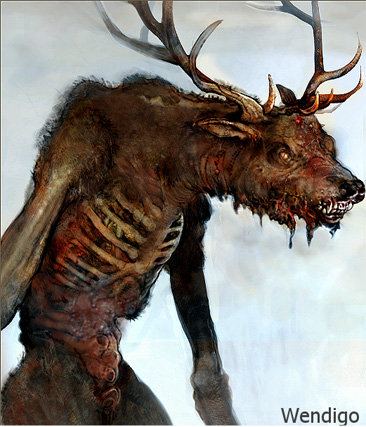
The wendigo (also known as windigo, weendigo, windago, waindigo, windiga, witiko, wihtikow, and numerous other names) is a demonic spirit believed by Algonquin-based Native American tribes to possess humans and turn them into cannibals. The term "Wendigo” is used to describe an evil spirit as well as a creature that humans can become when possessed by the spirit (Kingaton). Many legends and stories have circulated over the years about a mysterious creature that was encountered by hunters and campers in the forests. 

The Wendigo
 The Wendigo legend was prevalent in the northern United States, Northern Minnesota and Canada, and particularly roamed around woods and forests in the coldest areas where food was scarce and survival was challenging. But, Kenora, Canada is the place most known for its Wendigo sightings (Colombo). In one variation of the story, the creature could only be seen if it faced the witness head-on, because it was so thin that it could not be seen from the side. Though all of the descriptions of the creature vary slightly, the Wendigo is generally said to have glowing eyes, long yellowed fangs and overly long tongues. Most have a sallow, yellowish skin but others are said to be matted with hair. They are tall and lanky and are driven by a horrible hunger. The spirit was said to have a big appetite for human flesh and the many forest dwellers who disappeared over the years were said to be victims of the monster. “They’re hundreds of years old. Each one was once a man. Sometimes an Indian, other times a frontiersman or a miner or a hunter.” (Colombo)

According to lore, the Wendigo is created whenever a human resorts to cannibalism. During some harsh winter a guy finds himself starving, cut off from supplies or help he becomes a cannibal to survive, eating other members of his tribe or camp(Haden). Cultures all over the world believe that eating human flesh gives a person certain abilities such as speed, strength, and immortality. If you eat enough of it, over years, you become this less than human thing. Wendigos are said to be very hard to kill. The Wendigo have few weakness, as far as weapons are concerned it can only be killed by iron, steel and silver. The most gruesome method of disposal is by shattering the creature’s ice heart with a silver stake and then dismembering the body with a silver axe(Kingston).


Works Cited:

Colombo, John. Windigo: An Anthology of Fact and Fantastic Fiction. Canda. Modern Press.        1936. Print.

Haden, Blackman. The Wendigo: The North Woods of Minnesota. prairieghosts.com. Troy             
Taylor. 2002. 17 October 2012.

Kingston, W.H.G. “Adventures among the Indians.” Pararesearshers.org. John W. Lovell  company.1888.Web. 12 October 2012.

Medals, Henry. Wendigo. Photograph. http://monster.wikia.com/wiki/Wendigo, 22 February 2010. Web. 17 October 2012.


Links for further research:
This article gives information about the Wendigo and also talks about people giving speeches about the creature.

This website gives you more insight on the Windigo


This website compares the Wendigo to other creatures like Bigfoot.