Showing posts with label haint blue. Show all posts

Monday, October 31, 2022

Boo Hags, Their Origins, and How to Avoid Them

Author: Nabal Blight


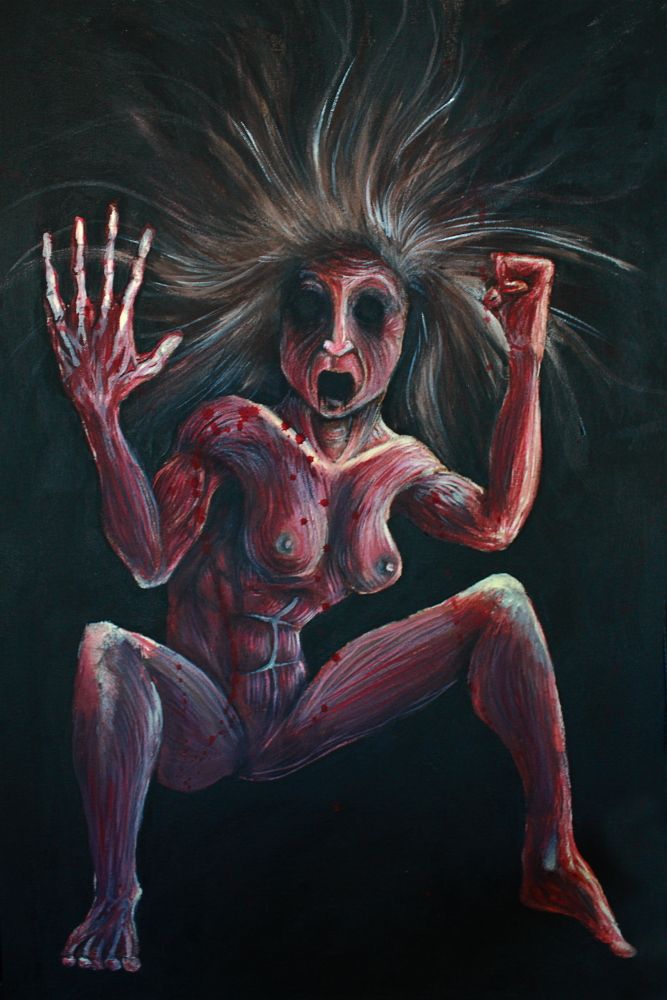
Most people have heard of vampires and witches, but have you heard of the infamous “boo hag?”  Boo hags are demonic creatures that exhibit both witch-like and vampire-like attributes.  Because they are skinless, boo hags steal the skin of human beings and wear it during the day as their own in order to pass undetected (“The Boo Hags of Gullah Culture”).  Consequently, in daylight, boo hags cannot be distinguished from normal people.  However, at night, boo hags shed their stolen skin and fly through the night, preying on hapless human beings.  At night, boo hags appear as skinless, bloody human figures with exposed veins and muscles, wild hair, and glowing eyes, or else they are invisible, detectable only by the humid, foul odor they carry with them (“Boo Hags & Haint Blue”; “The Boo Hags of Gullah Culture”).  During their nocturnal raids, boo hags slip into houses where they “ride” sleeping human beings, stealing their breath or life energy (“The Boo Hags of Gullah Culture”).  If a boo hag’s victim awakes while their breath is being stolen, the boo hag will steal the person’s skin as their next outfit (“Boo Hags & Haint Blue”).  However, if the victim stays asleep, the boo hag usually leaves them alive, in which case the person will wake up in the morning exhausted, despite having slept all night, because their energy has been sapped by the boo hag (“Boo Hags & Haint Blue”). 


“The Terrifying Skinless Witches of The American Southeast” (James Troup) 

The belief in boo hags originates from the culture of the Gullah people, an African American ethnic group from the coastal regions of South Carolina.  Gullah beliefs are closely connected to Hoodoo and emphasize the existence of various types of spirits called “haints.”  According to these beliefs, human beings have a soul, which goes either to heaven or hell at death, and a spirit, which remains on the earth (Carman; “The Boo Hags of Gullah Culture”).  If a person has lived a moral life, the spirit, or haint, they leave behind will be beneficent, whereas, if the person has lived an evil life, their haint will become a boo hag (“The Boo Hags of Gullah Culture”). 

While they are powerful, terrifying, and crafty, boo hags do have certain weaknesses whereby they can be warded off or destroyed.  Gullah tradition maintains that boo hags cannot survive in daylight without a borrowed skin (“The Boo Hags of Gullah Culture”).  Because of this, the best way to defeat a boo hag is to distract it while skinless until the sun comes up and destroys it.  Boo hags can be distracted by placing objects in their path that represent large numbers, because their compulsive nature will cause them to count the objects endlessly (“The Boo Hags of Gullah Culture”).  For example, setting a broom or brush on a bedroom floor will divert the attention of an intruding boo hag from the room’s occupant to counting the bristles of the brush or broom (“The Boo Hags of Gullah Culture”).  Other objects that can be used to distract boo hags are strainers or piles of rice or seeds (“The Boo Hags of Gullah Culture”; Carman).  Boo hags are also susceptible to salt or pepper.  Strewing salt on a floor or filling a Hag’s abandoned skin with salt or pepper will sabotage the boo hag’s stolen skin, preventing the hag from reentering its skin (“The Boo Hags of Gullah Culture”; Carman).  Another method is to hang empty blue glass bottles outside from a tree or frame, forming a “bottle tree.”  At night, boo hags enter the bottles and become trapped until the sun comes up and kills them inside (Parks).

Allegedly the most reliable way to deter boo hags and other evil spirits involves a special hue of blue paint, called “Haint Blue.” This specific color of blue paint originates from the South Carolina indigo dye industry of the 1700s, which depended on the slave labor of African Americans, especially the Gullah (Parks).

Indigo-colored Yarn from the Indigofera suffruticosa Plant (Judy Newland)


The Gullah were tasked with growing, harvesting, and processing the indigo plants to extract their rich blue dye, which was then exported from South Carolina to Britain.  After processing the dye, the Gullah would take the dregs of the dying vats and mix them with other ingredients to form a light aqua blue paint (Carman; Parks).  This light blue color came to be known as “Haint Blue.”  Gullah beliefs place a special significance on the color blue, and according to these beliefs, painting the exterior of a house in Haint Blue wards of evil spirits, including boo hags (Parks; Carman).  This is because boo hags are said to perceive the pale blue color either as water, which they cannot cross, or sky, which causes them to fly past the house (Parks; Carman).  Gullah traditions regarding haints and boo hags and the countermeasures that can be taken against them are still strong in certain regions of South Carolina.  As a result, many houses can still be seen along the South Carolina coast that have porches or window frames painted in Haint Blue.

Whether or not you believe in boo hags, these elusive and dangerous spirits and the Gullah beliefs regarding their behavior serve as a powerful lesson: one should not take everything at face value.  The next time you see the porch of a house painted blue or see bottles hanging from a tree, consider the possibility these things might not be intended as décor, and if you meet a stranger in the street, greet them politely and hurry on, because there might be more about them than is apparent. 

Works Cited:

“Boo Hags & Haint Blue: Vampires of the Lowcountry & the Paint that Stops Them.” Charleston Terrors, https://charlestonterrors.com/boo-hags-haint-blue-vampires-of-the-lowcountry-the-paint-that-stops-them/. Accessed 14 Oct. 2022.

Carman, Katie. “The Gullah Geechee Tradition of 'Haint Blue' Paint Keeps the Spirits Away.” HowStuffWorks, 27 May 2020, https://history.howstuffworks.com/history-vs-myth/haint-blue.htm. 

Newland, Judy. “Sea Island Indigo: Creating an American Indigo Culture.” ClothRoads: A Global Textile Market, 2018, https://i0.wp.com/assets-clothroads-com.s3.amazonaws.com/uploads/2016/02/Indigo-dyed-yarn.jpg?ssl=1. Accessed 19 Oct. 2022.

Parks, Shoshi. “What the Color ‘Haint Blue’ Means to the Descendants of Enslaved Africans in the Lowcountry.” Atlas Obscura, 14 Jan. 2020, https://www.atlasobscura.com/articles/what-haint-blue-means-to-descendants-enslaved-africans. 

“The Boo Hags of Gullah Culture.” Scares and Haunts of Charleston, 22 Apr. 2012, https://scaresandhauntsofcharleston.wordpress.com/2012/04/22/the-boo-hags-of-gullah-culture/. 

Troup, James. “The Terrifying Skinless Witches of the American Southeast.” YouTube, uploaded by BuzzFeed Unsolved Network, 24 Feb. 2022, https://www.youtube.com/watch?v=0Klc8UMyvD4. Accessed 20 Oct. 2022.


Links for further research: 

“The Boo Hag: Georgia Witch Story.” The Moonlit Road, https://www.themoonlitroad.com/the-boo-hag/ This website by Veronica Byrd and Craig Dominey tells a story, both in written and audio form, about a man who accidently married a Boo Hag.  

“Boo Hags.” South, https://www.southmag.com/boo-hags/ This article by Sloane Frederick, a writer on Southern culture and cuisine, provides information from an interview with Lisa Prentiss regarding Boo Hags and other paranormal activity in Savannah, Georgia.  

“Gullah Culture: Gullah in Beaufort, Port Royal & the Sea Islands.” Visit Beaufort: Port Royal and Sea Islands, https://www.beaufortsc.org/things-to-do/gullah-culture/  This article provides information regarding the history and heritage of the Gullah people in South Carolina, from the slave trade to the present day.

Sunday, December 5, 2021

Skinless Creature

 by Aalayna Bolton

Veronica Byrd told an interesting story about a young man who suspected that his beautiful wife might be a BooHag. While BooHags are considered an urban legend they are real to the Gullah culture as creatures that are similar to vampires who feed on the unsuspecting and vulnerable people nearby. In this story the young man named Emmet was looking for love when he found a beautiful woman to marry. People around town were warning him that she was strange and he needed to stay away from her. He married her anyway. After their marriage he started to notice on certain nights at midnight his wife was nowhere to be found. He got worried and thought she was seeing someone else. He ranted to his friend about what was going on and his friend told him that she might be a BooHag. One night he looked in the closet and saw his wife’s skin hanging up. He put salt and pepper inside her skin. When his wife returned that night, he saw her skinless. When she put her skin on it was burning her alive and she eventually died. Although BooHags are dangerous, widespread and unnatural they have a rich history and there are ways to repel and protect against them.

Robin Jarvis explains the legend of Gullah culture and the origin of the BooHag. He states that, “The seas Islands and the Coastal plains of the Southern Coast of South Carolina are home to a culture rich in African Heritage.” The heritage site is called “Gullah” after the creole language spoken there. The Gullah people along South Carolina’s coast have a culture all their own. Their culture is well-respected by other South Carolinians. Part of their culture involves the legendary tale known as “Folklore” of the BooHag. The Gullah people believed that if a person did not make it into heaven they became a BooHag instead of going to Hell. 

Author, Kyle Van Helsing gives information about what a BooHag does. He states, “A BooHag is a vampire-like creature. It’s similar to the vampire of Central and Eastern European folklore. The BooHag sits on the chest of their victim while “riding” them.” BooHags steal their victim’s breath while they are sleeping and they wake up tired. BooHags live in abandoned houses that are deep within the swamps of South Carolina. The BooHag’s appearance is difficult to miss as the BooHag has no skin to call its own. He states that, “Since the BooHag has no skin, its muscles, tendons, and arteries are exposed.” This is why the BooHag steals the skin from victims who struggle to fight with them during the attack. They eventually kill the victim and wear the skin as its own. During the day, the Hag appears to be a young and beautiful lady. At night the Hag removes its skin and takes off into the night sky to look for victims.”

Sloane Frederick provides information about how to get rid of a BooHag and Shannon Scott provides another way. Sloane explains that getting rid of a BooHag requires you to use a broom because it will attach itself to the broom once it jumps out of its victim. Then it can be swept out the door. Shannon explains how some Gullah people practiced voodoo to rid themselves and others of BooHags. The Gullah used paint called the “Haint blue” paint because it kept the haints  away.” Haint was another word for an evil spirit or BooHag.

BooHags have been around for years as they find their roots in Gullah culture. They are a myth but many people recognize them as being real. They are the source of many superstitions and there are ways to protect and defend against them. Always keep a broom near and be educated on what they are.

Works Cited:

Veronica Byrd. “The Boo Hag: Georgia Witch Story.” The Moonlit Road. Oct. 2012.
https://www.themoonlitroad.com/the-boo-hag/. Accessed 18 Oct. 2021

Sloane Frederick. “Boo Hag.” South. Dec. 2017. https://www.southmag.com/boo-hags/. Accessed
18 Oct. 2021.

Kyle Van Helsing. “The Boo Hag.” The Demon Hunter’s Compendium. March 2013. The Demon
Hunter's Compendium: The Boo Hag (demonhunterscompendium.blogspot.com).
Accessed 18 Oct. 2021.

Robin Jarvis. “The Creepy South Carolina Legend That Will Keep You Awake At Night.” Only In
Your State
. May 2018. https://www.onlyinyourstate.com/south-carolina/gullah-culture-boo-
hags-sc/. Accessed 18 Oct. 2021

Shannon Scott. “The BooHags by Lisa Marie.” Shannon Scott Tours. March 2019.
https://www.shannonscott.com/the-boo-hags-by-lisa-marie/. Accessed 18 Oct. 2021