The world is a mysterious place. The can of mystery highlights some of those mysteries. This site is a class project for Amanda Warren's English 101 class at the University of South Carolina Aiken.
Articles are uploaded once a year (on average) in the fall and/or spring.
If you have questions or tips on mysteries, please leave a comment or contact AmandaW at USCA dot EDU.
The Moon-eyed people are a short mysterious figure in Cherokee and Appalachian folklore, very often described as a pale-skinned, blue-eyed race sensitive to sunlight, living in the Appalachian Mountains before European settlers arrived. Legends say they inhabited areas like the Smoky and Blue Ridge Mountains and built stone structures, including Georgia's Fort Mountain wall. Due to their sensitivity to light, they could only see at night, hiding during the day and working during the night fall.
The Moon Eyed People were, according to legend, cave dwellers who only ventured out at night.
Cherokee stories talk about conflicts between the Cherokee and the Moon-eyed people around 1100-1200 AD, which drove them away. Some legends suggest they fled underground, disappearing from history. Theories on their origins vary, some propose they were an indigenous group or displaced settlers from Wales, tracing their origins to the 12th-century Prince Madoc legend. Now people add a paranormal twist, suggesting they may have been ailes, a theory transpired from their unusual physical traits and nocturnal-like habits. Some link the story to the 1955 Kelly-Hopkinsville "alien" encounter in Kentucky.
Legend of the Moon Eyed People, America's First Civilization
Today, the Moon-eyed people are a captivating part of Appalachian culture, where Native history, European legends, and supernatural tales merge. Their story, passed down through generations, continues to intrigue and inspire those drawn to the mysteries of Appalachia.
Works Cited:
Carmichael, Tim. “The Moon-Eyed People of Cherokee Legend: Mysteries of the Smoky Mountains.” Echoes of Appalachia, 26 September 2024. Accessed: 6 Nov. 2024. https://appalachianmemories.org/2024/09/26/the-moon-eyed-people-of-cherokee-legend-mysteries
Hocker,Chris. “The Moon-eyed People”. Strange Carolinas, June 2012. Accessed: 6 Nov. 2024. https://www.strangecarolinas.com/2019/10/the-moon-eyed-people-effigy-murphy-nc.html. -of-the-smoky-mountains/.
Wayne, Jordan. “Blue Ridge Tales, Maintain Life & Love: Tales of the Moon-eyed People”. 2012. Accessed: 6 Nov. 2024. https://blueridgetales.com/tales-of-the-moon-eyed-people/.
Spooky Appalachia: The Story Of The Moon-eyed People.” Accessed: 6 Nov. 2024. https://www.spookyappalachia.com/the-story-of-the-moon-eyed-people/.
Vučković, Aleksa. “Exploring The Mysterious North American Moon-eyed People Legend.” Ancient Origins, 23 January 2022. Accessed: 6 Nov. 2024. https://www.ancient-origins.net/myths-legends-americas/moon-eyed-people-0016334.
For Further Reference:
Voyles, Bruce. “Moon-eyed People Legends Center In Area.” Cherokee Scout. Accessed: 6 Nov. 2024. https://www.cherokeescout.com/opinion/moon-eyed-people-legends-center-area
This article work by James Mooney includes references to the Moon-eyed people and mentions Cherokee legends and folklore, providing valuable historical context. Mooney discusses how Cherokee oral tradition describes the Moon-eyed people as small, fair-skinned figures who lived in Appalachia before the Cherokee arrived.
Georgia Parks Division, Department of Natural Resources. "Historical Marker at Fort Mountain." 19, Sep. 2008. Accessed: 6 Nov. 2024 https://www.hmdb.org/m.asp?m=11590
This marker, placed by Georgia’s Department of Natural Resources, commemorates the Moon-eyed people and their alleged connection to Fort Mountain’s stone wall. It includes the belief that the Moon-eyed people may have been a separate race defeated by the Creek. A notable example of how folklore has been recognized in historical landmarks, encouraging ongoing curiosity about local legends.
Atlas, Obscura. “Who Were the Mysterious Moon-Eyed People of Appalachia?” by Hadley Meares, October 22, 2024. Accessed: 6 Nov. 2024. https://www.atlasobscura.com/articles/moon-eyed-people-appalachia
This article explores various versions and theories about the moon-eyed people, diving deep into archaeological evidence, Cherokee legend, and speculative folklore. The author describes how the myth evolved through both indigenous and European storytelling, as well as modern alien theories.
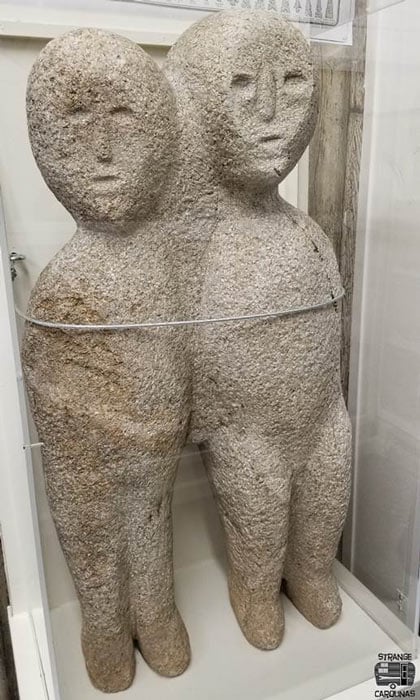
A stone pair of
moon-eyed people from murphy, South Carolinas
The statue is found in the Cherokee legend of the moon-eyed people. Believed to be centuries old, the effigy was carved out by tapping another rock, eventually revealing a two-headed figure with round eyes too large for their faces (Howard). According to legend, it is the Moon-Eyed people.
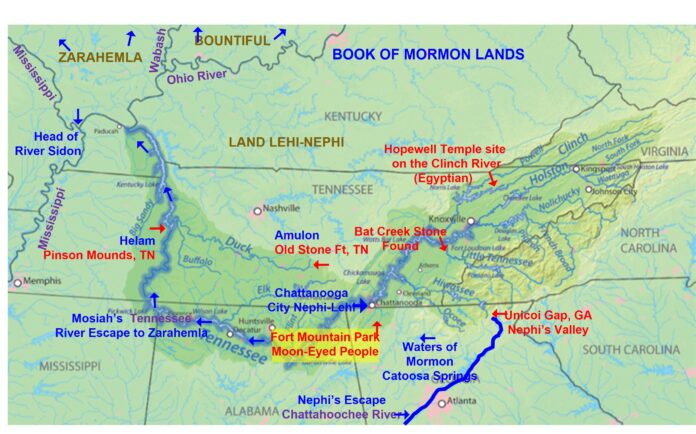
Nephi’s Land
According to the Mormon legend, the Moon-eyed people lived before Columbus in Northern Georgia, southeast Tennessee, and the southwest part of North Carolina (Nelson). This map connects the possibility that the moon-eyed people were the Nephites. Because the moon-eyed people were continuously moving around Fort Mountain Park is a crucial piece of evidence that due to the proximity with the Mormon people. The movement of the moon-eyed people is along Mormon territory and marks Nephites, similar to the moon-eyed people's migration.
Legend of the Moon Eyed
People
Cherokee discovered the reoccurring stone structures in the Blue Ridge Mountains of North Carolina, and the Cherokee say the moon-eyed people built them. The moon-eyed people were a race of fair-skinned, light-haired bearded humans. Their large blue eyes were so sensitive to the sun that they lived in caves and came out only at night (The Why Flies). Although they lived in the same area as the Cherokee nation, they were from the Appalachian Mountain. The connection to Prince Madoc of Wales is because he sailed to Mobile Bay, Alabama, left, and then came back to Alabama and never heard from again, which is why moon-eyed people believed to be the Welsh Indians. Morgan Jones, a Welsh minister, and Stedman, a sailor, both encountered the Welsh tribe that is said to have built the stone structures all along the Appalachian Mountains. The first governor of Tennessee, John Sevier, was told by an Indian chief that the statue wasn't built by American Indians but by the Welsh living in that area. The moon-eyed people used technology unknown to other tribes, like rounded-out boats instead of canoes. Cherokee said the moonlight people driven West few people were a tribe who lived in Utah and parts of California, a tribe of red-haired giants with white skin who lived in caves (The Why Flies). They feared the sun, and they only came out at night now (The Why Flies). People were at war with red hair for many years, and eventually, they were able to trap the white-skinned giants in the caves (The Why Flies). They then set a massive fire in killed them all (The Why Flies).
Works Cited:
Howard,
Krissy. “The Ancient Moon-Eyed People Of North Carolina: Fact Or Fiction?” All
That’s Interesting. 10 Jan. 2017.
https://allthatsinteresting.com/moon-eyed-people. Accessed 18 Oct. 2022.
Strange
Carolinas. stone pair of
moon-eyed people. n.d. Photograph. “Exploring the Mysterious North American
Moon-Eyed People Legend “, Ancient Origins, 23 Jan. 2022 stone_9.jpg
(420×700) (ancient-origins.net). Accessed 25 Oct. 2022
Howard, Krissy. “The Ancient Moon-Eyed People Of North Carolina: Fact Or Fiction?” All That’s Interesting. 10 Jan. 2017. https://allthatsinteresting.com/moon-eyed-people. Accessed 18 Oct. 2022. Krissy Howard discusses the moon-eyed people of the Appalachian Mountains in this article. It's an overview describing their connection to Prince Madoc, their war with the Cherokee, and being attacked by the Creek tribe from the south. Using the Cherokee legend, this article explains who the moon-eyed people were.
Nelson,Rian.” White Moon-Eyed People.” Book of Mormon Evidence. 24 July 2021. https://bookofmormonevidence.org/white-moon-eyed-people/. Accessed 18 Oct. 2022. Rian Nelson's article connects the moon-eyed people to Fort Mountain State Park. There is a discussion of their war with the Cherokees and how they might have been Nephites.
Tibbs, David.” Legends of Fort Mountain The Moon-Eyed People / Prin2ce Madoc of Wales.” The Historical Marker Database. 19 Sept. 2008. https://www.hmdb.org/m.asp?m=11590. Accessed 18 Oct. 2022. Tibbs writes about different moon-eyed people legends, including the Delaware Indian legend and the Legends of Fort Mountain. They received names from various tribes, such as Allegewi, and Cherokee Chief Oconostota spoke of his interactions with them and where they were located.