Showing posts with label Christian Catacombs. Show all posts

Wednesday, October 23, 2013

Catacombs of Rome

Author: Denterria Edmond

Not many people actually know what catacombs are, let alone where they exist, and what they are use for, there actual purpose. According to the many sources I have used to conduct this research on this quite strange and unusual topic, catacombs are “underground passages and rooms once used for the burial of the dead” (Duchesne). Catacombs were created because the Romans needed more space for burials. It has been said that catacombs held people who were not following the same religious beliefs that the roman government had set for everyone, which was Christianity. Roman catacombs actually had more uses to them than just burial sites for Christians and Jews. “Besides serving as places of burial, the catacombs were used as hiding places from persecution, as shrines to saints and martyrs, and for funeral feasts” (Adams). So as you can see as the centuries went on catacombs began to expand and become more than just homes for the dead.
:This image shows an actual Christian catacombs and how some of them actually look. 
They were all made differently.
Catacombs vary in size. The largest known and most popular are the catacombs of San Callisto which reaches about 19 kilometers long, in 5 levels high, and goes about 20 meters deep. The catacombs of San Callisto are about 2000 years old and are still being toured daily. The San Castillo catacombs were actually expanded by Callistus the 1st who is also buried in these catacombs. Before Callistus died he was actually a known pope of Rome, that’s how this catacomb became known after him, and because he was the one that actual put a time and effort into expanding it. “The catacombs were expanded to not only include more tombs, but also chapels, meeting areas, dining rooms, and places to sleep” (WorldSiteGuides). This became known as one of the most important catacombs because of the many people known to be buried here. “Over the course of history more than 50 martyrs and 16 popes have been buried here making it one of the most important Christian cemeteries” (WorldSiteGuides).

This video takes you on an actual virtual tour about the catacombs of San Callisto and goes into more depth about the information given above.

Works Cited
"Catacombs." The Columbia Encyclopedia. New York: Columbia University Press, 2013. Credo Reference. Web. 19 October 2013.
"Catacombs." The Classical Tradition. Cambridge: Harvard University Press, 2010. Credo Reference. Web. 19 October 2013.
"Catacombs." The Columbia Encyclopedia. New York: Columbia University Press, 2013. Credo Reference. Web. 19 October 2013.
WorldSiteGuides. “Catacombs of San Callisto.” Youtube.com. Google. January 18, 2011 .Web. 19 October 2013.

Links for Further Research:
RickSteves. “Roman, Italy: Catacombs and Appian Way.” Youtube.com. Youtube. June 8, 2009. Web. October 2013.
The link above is a video that shows two men going on a tour of the ancient and abandoned catacombs.

Vatican May Yield to Jews Two Catacombs Under Rome. (1977, Apr 06). The Washington Post (1974-Current File). Web.  19 October 2013.
The link above takes you to an article which talks about the Jewish catacombs controlled by the Vatican’s that could possibly be handed over to the Italian government because of its importance to them.

The Catacombs of Rome. (1876, Feb 13). New York Times (1857-1922). Web. 19 October 2013.
The link above talks about how everything pretty much having to do with catacombs and how they began with the Italians.


Monday, October 22, 2012

Catacombs of Rome

Author: Olivia Ray 

The Catacombs of Rome are one of the most interesting and popular sights in Rome. Forming an underground maze in the outskirts of the city, the catacombs provide a rare glimpse into the earliest centuries of Christianity. In addition to the countless burial chambers that line the tunnels, the catacombs are home to some of the earliest examples of Christian art. The burial custom of most ancient Romans tended to be cremation, with ashes stored in urns. But Christian belief in the bodily resurrection led the early Christians to reject this practice and bury their dead instead. This method requires significantly more space, of course, and the early Christians did not own much land. So the catacombs made a practical, even necessary, solution for burial of the faithful. (“Early Christian...”)


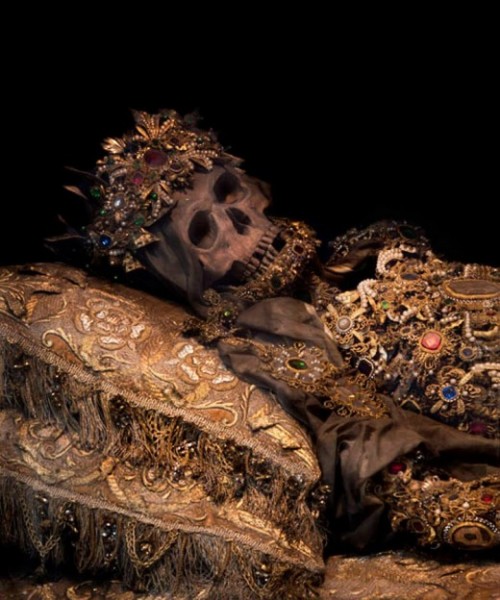
 St Deodatus; “Taken from the catacombs of Rome in the 17th century, the relics of twelve martyred saints were then attired in the regalia of the period before being interred in a remote church on the German/Czech border.”
The catacombs had other advantages as well: they were an ideal way to strengthen the sense of Christian community (both in life and death) and they provided quiet, out-of-the-way places for memorial ceremonies and displaying Christian symbols. The first large-scale Christian catacombs were excavated in the 2nd century AD. They were all located outside the city walls, as Roman law forbade burial within the city limits. In addition to burial, the catacombs were used for memorial services and celebrations of the anniversaries of Christian martyrs. (“Early Christian...”)
In these catacombs, there are different crypts of the most important people in the church. The most significant was the Crypt of the Popes.  It is called "The Little Vatican" as it was the official burial place of nine popes and, probably, of eight dignitaries of Rome's 3rd century Church. In the walls you can still see the original inscriptions, in Greek, of five popes. On four tombstones, near the name of the pope, there is the title of "bishop", since the Pope was regarded as the head of the Church of Rome, and on two of them there is the Greek abbreviation of MPT for "Martyr". The names of the five popes were Pontianus, Antherus, Fabian, Lucius and Eutichian. In the front wall was laid to rest Pope Sixtus II, a victim of Emperor Valerian's persecution.  (“Following the…”).


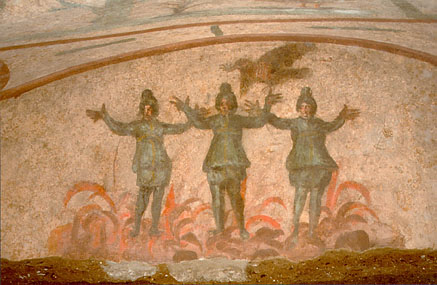
 Rome, Catacombs of Priscilla – three children in the furnace


 The art of the catacombs is another significant feature.  From the end of the second century, an extremely simple art developed in the catacombs which is in part narrative and in part symbolic. The paintings, mosaics, reliefs on the coffins and minor arts recall stories from the Old and New Testaments, as if to present the examples of salvation from the past to the new converts. This is why Jonah is often portrayed; being that he was saved from the belly of the whale where he remained for three days, which re-evokes Christ’s Resurrection. There are also representations of the young people of Babylonia rescued from the flames of the furnace; as shown above, Susan saved from the snares of the elders, Noah who escaped the flood, and Daniel who stayed unharmed in the lions’ den. (“The Christian…”).

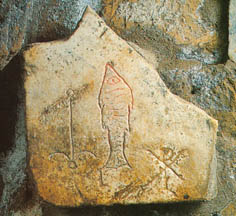
Rome, Catacombs of St. Sebastian – Funeral inscription with symbols
 The art of the catacombs is also a symbolic art in the sense that some concepts which are difficult to express are represented in a simple way. To indicate Christ, a fish is depicted; to signify the peace of heaven, a dove is represented; to express firmness of faith, an anchor is drawn. On the closing slabs of the loculi, symbols with different meanings are often engraved. In some cases, a tool is depicted which indicates the dead person’s trade in life. Some symbols, such as glasses, loaves of bread and amphorae, allude to the funeral meals consumed in honor of the deceased, the so-called refrigeria. Most of the symbols refer to eternal salvation, such as the dove, the palm, the peacock, the phoenix and the lamb. (“The Christian…”).
According to the Fox news, the earliest known icons of the Apostles Peter and Paul have been discovered in a catacomb under an eight-story modern office building in a working-class neighborhood of Rome. The images, which date from the second half of the 4th century, were discovered on the ceiling of a tomb that also includes the earliest known images of the apostles John and Andrew. They were uncovered using a new laser technique that allowed restorers to burn off centuries of thick white calcium carbonate deposits without damaging the dark colors of the original paintings underneath. (“Archaeologists…”).
It is said that Christians built these catacombs in order to “hide out” during Christian persecution. In my view, they wanted a safe and proper way to bury the dead of their loved ones. They also put a lot of work and effort into these catacombs. Not only were they places to bury their dead, but they were places to paint their magnificent art on the superior tombs of their beloved ones telling their story to others. 


Works Cited:
"Archaeologists Find Oldest Paintings of Apostles in Roman Catacombs." Fox News. FOX News Network, 22 June 2010. Web. 18 Oct. 2012.

"Early Christian Catacombs, Rome." Early Christian Catacombs. Sacred Destinations, 6 Dec. 2009. Web. 18 Oct. 2012.

"FOLLOWINGS THE ITINERARIES." The Catacombs of St. Callixtus. Salesian Istitute S.t Callixtus, Rome. The Christian Catacombs of Rome. Istituto Salesiano San Callisto - Rome, n.d. Web. 18 Oct. 2012.

"The Christian Catacombs." The Christian Catacombs. N.p., n.d. Web. 18 Oct. 2012.

Cited Images:
"Rome, Catacombs of Priscilla – Three Children in the Furnace." Vatican: The Holy See. N.p., n.d. Web. 18 Oct. 2012.

"Rome, Catacombs of St. Sebastian – Funeral Inscription with Symbols." Vatican: The Holy See. N.p., n.d. Web. 18 Oct. 2012.

"St Deodatus." Tumblr.com. N.p., Aug. 2012. Web. 16 Oct. 2012.

Links for further research:

Christian Catacombs of Rome
http://www.bibleprobe.com/catacombs.htm
Articles and information on the most important Christian people during the time that
catacombs came to exist.

Early Christian Symbols of the Ancient Church from the Catacombshttp://www.jesuswalk.com/christian-symbols/
This website has information about the Christian symbols and their origin. It also has links to different picture collections and historical studies on each.

The Christian Catacombs
http://www.vatican.va/roman_curia/pontifical_commissions/archeo/inglese/documents/rc_com_archeo_doc_20011010_cataccrist_en.html#Arte
This website provides information on the catacombs such as the origin, art, and characteristics.